Step-by-Step Guide: Registering a Private Limited Company in India (DSC, DIN, MCA Portal)
India's Digital Leap: A New Era for Company Registration
In 2025, India will become one of the world's fastest-growing destinations for business incorporation. According to the Ministry of Corporate Affairs, company incorporations surged by over 29% in May 2025 compared to the same period last year. This surge reflects the success of India's digital reform, where every stage—from name reservation to incorporation—is now completed entirely online via the MCA's SPICe+ platform. For entrepreneurs from the United States and beyond, this means India is no longer a complex maze of paperwork but a digitised gateway to one of the largest emerging markets on Earth. The Private Limited Company remains the preferred structure—combining credibility, limited liability, and investor-readiness. The question is no longer why India, but why wait?
The Rise of the Private Limited Company: Why India Is the Next Big Frontier
The Private Limited Company (Pvt Ltd) remains the most widely adopted corporate form for entrepreneurs in India. According to the Ministry of Corporate Affairs (MCA), as of 31 January 2025 there were 28,05,354 registered companies, of which 18,17,222 (about 65%) were active. While the MCA figures do not provide a public breakdown showing exactly how many of these active entities are specifically "Private Limited Companies", the strong majority of new registrations use this structure, especially for growth-oriented enterprises.
The company registration process in India has been significantly simplified through the Ministry of Corporate Affairs integrated SPICe Plus (Simplified Proforma for Incorporating Company Electronically Plus) form. This single-window system allows entrepreneurs to complete multiple steps such as name reservation, company incorporation, and automatic allotment of PAN, TAN, EPFO, ESIC, and Professional Tax where applicable, within one streamlined application. Thanks to this digital transformation, the average time for incorporating a Private Limited Company has reduced considerably. In many straightforward cases, registration can be completed within about 7-10 working days; however, depending on factors such as name approval, documentation accuracy and regional processing times, it may extend to 10-15 working days or more.This marks a major improvement compared to earlier years, when company incorporation often took several weeks or even months.
Importantly, the Pvt Ltd structure continues to carry strong credibility: under the Companies Act 2013 it offers a separate legal personality for the company and limits liability of shareholders to their shareholding amount. Many investors and venture capitalists favour this model because it facilitates equity transfers, legal recognition and readiness to raise capital.
Is a Private Limited Company Right for Your Business?
Foreign investors and entrepreneurs should evaluate whether a Pvt Ltd company suits their business goals. Key considerations include:
- Investor Readiness:Preferred structure for venture capital, equity transfers, and institutional investment.
- Liability Protection:Shareholders’ liability limited to shareholding amount.
- Compliance Requirements:MCA annual filings, board meetings, and regulatory obligations.
- Scalability:Suitable for startups and growth-stage companies planning expansion in India.
The Journey: From Digital Signature to Incorporation Certificate
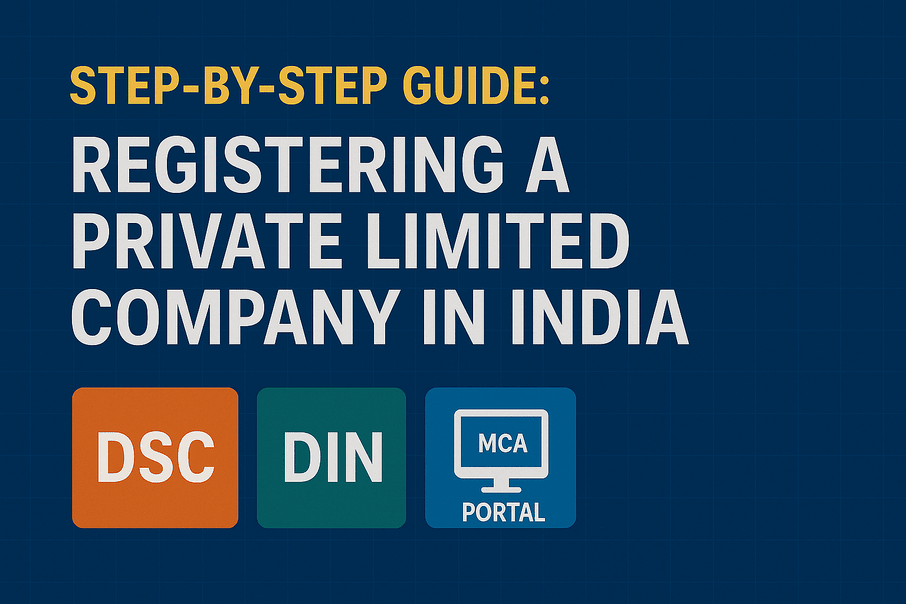
Registering a Private Limited Company in India follows a well-defined digital pathway. It begins with acquiring a Digital Signature Certificate (DSC) for every director and subscriber—your passport to legally sign electronic documents. Next comes the Director Identification Number (DIN), a unique code for each director under the Companies Act 2013. Once these are secured, the journey continues with name reservation and SPICe+ filings on the MCA portal, where the company's Memorandum (MOA) and Articles of Association (AOA) are also submitted.
A remarkable feature of 2025's system is that PAN, TAN, EPFO, and ESIC registrations are integrated into a single window. Once approved, the Certificate of Incorporation (COI) is issued—complete with your unique Company Identification Number (CIN).
One of the best real-world examples of this process in action is Phool.co (formerly Kanpur Flowercycling Pvt Ltd). Founded in 2017, the company used the Private Limited structure to scale rapidly and attract funding from major global investors. Its success story illustrates why proper legal structuring from day one is critical: the Pvt Ltd form gave it credibility, compliance readiness, and access to institutional capital.
For foreign founders, especially those based in the United States, the same process applies—with the additional requirement of appointing at least one resident Indian director and submitting apostilled identity proofs. Once incorporated, the company enjoys full legal standing in India, with the freedom to operate, invoice clients, and open bank accounts.
Challenges, Solutions & The Future of Incorporation in 2025
While the process is vastly improved, a few common challenges persist. Document inconsistencies remain the most frequent cause of delays; mismatched names or outdated addresses between PAN and identity proofs can trigger rejections. Another common issue is securing a compliant registered office in India—a legal necessity under the Companies Act. Many foreign founders resolve this by using verified service addresses or co-working offices.
Compliance doesn't end with incorporation either. Annual filings, board meetings, and accounting standards must be maintained to remain in good standing with the MCA. However, the government's 2025 updates—introducing pre-filled digital returns and AI error-detection—are making compliance less painful than ever.
Looking ahead, experts predict full-scale automation of incorporation by 2026, where AI-driven verification will reduce human processing time to under three working days. For entrepreneurs, this means faster market entry and smoother integration into India's booming start-up ecosystem, which is projected to triple its unicorn count by the end of 2025.
The Practical Toolkit — Your Private Limited Registration Blueprint
Before you begin, assemble a complete incorporation pack: two unique company names, Digital Signature Certificates (DSCs) and Director Identification Numbers (DINs) for all directors, notarised ID and address proofs, and your draft Memorandum and Articles of Association (MOA & AOA). Confirm that your registered office—whether leased or virtual—is fully verified with the required NOC and utility bill.
Through the MCA's SPICe+ portal, you can now reserve your name, apply for DIN, PAN, TAN, EPFO, and GST in one unified form, pay the statutory fees, and track your application in real time. With accurate documentation, most incorporations are approved within 7-10 working days.
For first-time founders, one rule ensures success: digitise everything, verify every document twice, and engage a qualified Indian Company Secretary if in doubt.
FAQ's About Private Limited Company Registration
What is the minimum number of directors and shareholders for a Private Limited Company?
A Pvt Ltd requires a minimum of 2 directors and 2 shareholders. Foreign investors must appoint at least one resident Indian director.
Can a foreigner fully own a Private Limited Company in India?
Yes, under the automatic FDI route in most sectors. Certain strategic sectors may require government approval.
How long does it take to register a Private Limited Company?
With accurate documentation and SPICe+ filing, incorporation usually takes 7–10 working days. Delays can occur due to name approval or document errors.
Do I need a physical office in India for registration?
Yes, a registered office is mandatory. Verified service addresses, co-working spaces, or leased offices are acceptable.
Start Your Private Limited Company Registration in India Today”
Secure your investor-ready Pvt Ltd company in India with expert guidance. Get end-to-end support from digital signature to post-incorporation compliance—begin your registration now!
Recent Notifications & Updates — What's New on the MCA Front
In January 2025, the Ministry of Corporate Affairs (MCA) enhanced its SPICe+ interface under the MCA21 Version 3 platform, merging name approval, incorporation, and statutory tax registrations into a single, unified workflow. The August 2025 amendments to the Companies (Incorporation) Rules, 2014 strengthened compliance monitoring for new companies, ensuring timely filing of commencement and annual returns.
Notably, foreign founders now benefit from AI-assisted digital document verification, reducing manual review and resubmission times by nearly 40%. Together, these updates reaffirm India's commitment to simplifying business creation and maintaining one of the most advanced incorporation ecosystems globally.
Incorporate Today, Lead Tomorrow
Registering a Private Limited Company in India is no longer a bureaucratic ordeal—it's a strategic gateway to one of the fastest-growing economies in the world. The 2025 reforms have transformed incorporation into a digital, transparent and efficient experience. For U.S.-based founders, the opportunity lies not just in market access but in credibility: a Private Limited entity is the most investor-trusted structure in India.
At CrossVentura, we guide entrepreneurs through every step of their India-entry journey—from digital signature to post-incorporation compliance. Ready to make India your next growth destination? Begin your registration today.
Read More on India Market Entry & Compliance
- FDI in India 2026: Latest Policy Updates & 100% Ownership Sectors
Explore the 2026 investment landscape, including the 100% FDI liberalization in the insurance sector and the SWAGAT-FI framework for trusted foreign investors.
- India’s Incentive Schemes for Startups & MSMEs: Grants, Tax Breaks & Support
A guide to the 2026 Section 80-IAC tax holiday extensions and how to leverage the Udyam system for simplified MSME benefits and scale-up funding.
- GST Compliance in India – 2026 Checklist for Startups and Foreign Companies
Stay compliant with the ₹5 crore e-invoicing threshold and the mandatory 30-day upload window to protect your Input Tax Credit (ITC) under the new IMS rules.
- Choosing the Right U.S. Entity: LLC vs C-Corp (for Foreign Founders)
Strategize your global expansion by comparing the pass-through simplicity of an LLC against the venture-readiness and 21% flat tax rate of a U.S. C-Corp.
- Step-by-Step Guide: Registering a U.S. Company as a Non-Resident in 2026
Practical steps for Indian founders, covering EIN acquisition via Form SS-4 and the strict 30-day Beneficial Ownership Information (BOI) filing rules for 2026.